
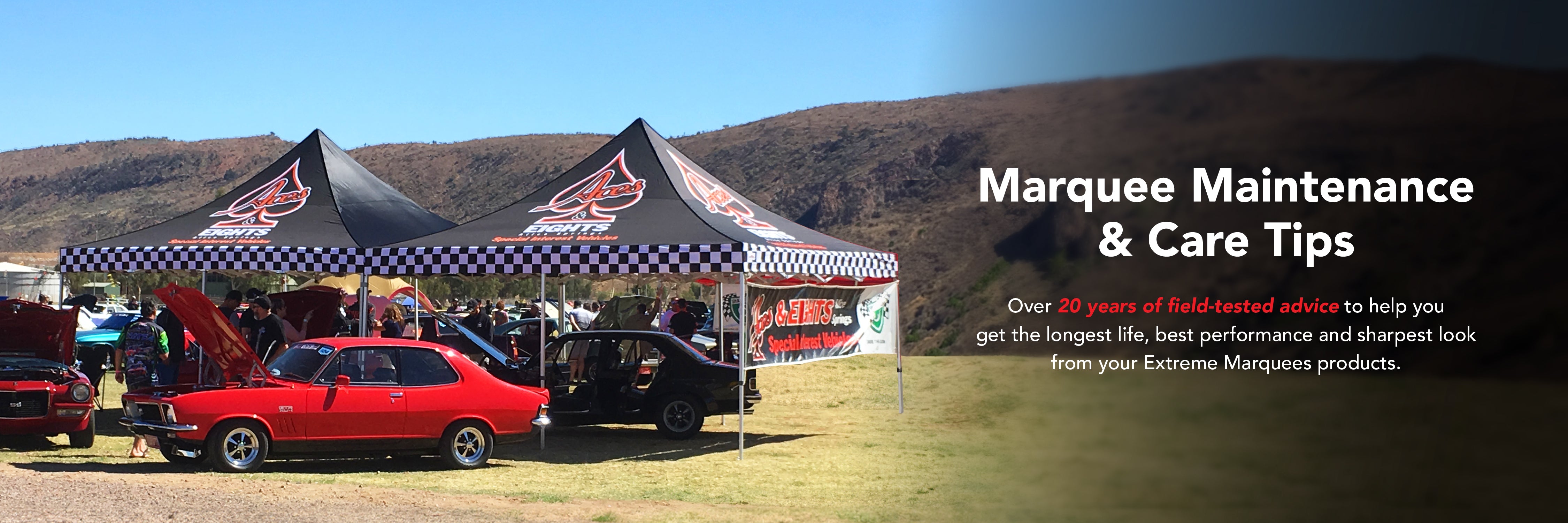
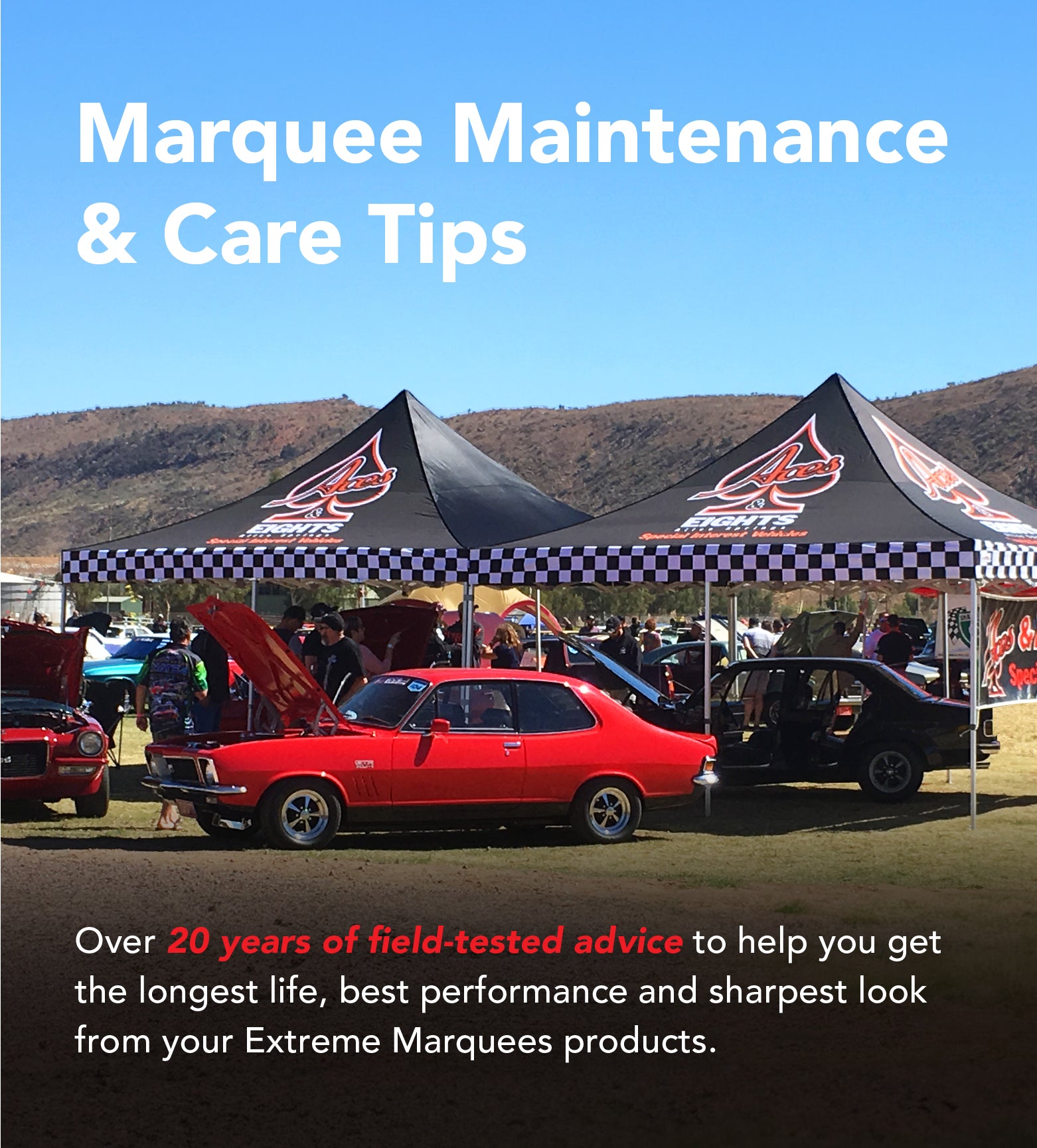
Marquee Maintenance & Care Tips
Your marquee is an investment — whether it's a custom-printed X5 True Blue for your weekend market stall or a heavy-duty X7 Tectonic anchoring your corporate event calendar. We've been building, printing and testing marquees since 2003, and in that time we've learned exactly what makes one last ten years instead of two. This guide is everything our warehouse team, our graphic designers and our most experienced customers wish every buyer knew from day one.
Jump to a Section
1. How to Clean Your Marquee
The golden rule of marquee cleaning is this: never, ever put your canopy in a washing machine or dryer. We've seen it happen more often than you'd think, and the heat and agitation will destroy the waterproof coating and ruin your print. Here's what to do instead.
Routine Cleaning (After Every Few Uses)
Set up your marquee in the backyard or lay the canopy flat on a clean surface — not rough concrete, which can scuff printed fabric. Use a garden hose with a gentle spray to rinse off loose dirt, dust and pollen. For most light soiling, this is genuinely all you need.
Deep Cleaning (Quarterly or As Needed)
- Mix a mild cleaning solution
A bucket of lukewarm water with a squirt of standard dishwashing liquid. Avoid bleach, caustic cleaners, or anything containing solvents — these will strip the PVC coating and fade printed artwork over time. - Use a soft brush or microfibre cloth
Gently scrub the affected areas in a circular motion. For stubborn marks on PVC canopies, a soft-bristle car wash brush works brilliantly. On printed polyester canopies, stick to a cloth to protect the dye sublimation print. - Rinse thoroughly
Make sure all soap residue is washed away. Leftover detergent can attract dirt and cause streaking, especially on white or light-coloured canopies. - Dry completely before storing
This is the step most people skip and it's the one that causes the most damage. A damp canopy packed away will grow mould within days, particularly in Queensland's humidity. Leave it set up to air-dry, or hang it over a clothesline in the shade.
Dealing With Mould & Mildew
If you've opened your carry bag to discover mould spots, don't panic. Mix one part white vinegar with four parts water, apply it to the affected area, and let it sit for 30 minutes before gently scrubbing with a soft brush. Rinse and dry thoroughly in the sun — UV light is a natural mould killer. For severe cases, a purpose-made mould remover designed for outdoor fabrics (available from most automotive or camping stores) will do the trick, but always test on a small hidden area first.
⚠️ Never use a pressure washer on your canopy.
The high-pressure water jet can damage the waterproof coating, delaminate printed layers and even force water through the fabric weave. A standard garden hose on a gentle setting is all you need.
2. Proper Storage
How you store your marquee between uses has more impact on its lifespan than almost anything else. We've seen brand-new custom-printed canopies ruined in three months by bad storage, and we've seen well-cared-for X7 Tectonics going strong after eight years of weekly markets.
✅ Always Dry Before Packing
This is rule number one. A damp canopy packed into a bag creates a sealed, humid environment that is essentially a mould factory. Even on a time-pressed pack-down day, give the canopy 15–20 minutes to air dry, or towel off standing water before rolling.
✅ Store Indoors, Off the Ground
Your wheeled carry bag is designed for transport, not long-term storage on a concrete garage floor where moisture can wick in. Store your marquee on a shelf, off the ground, in a dry, ventilated area away from direct sunlight.
✅ Loosen the Bag — Don't Compress
There's no award for cramming everything in as tight as possible. A loosely packed bag allows airflow and prevents permanent creasing in printed canopies. If your canopy and frame are in separate bags, even better.
❌ Never Store in Direct Sunlight
Prolonged UV exposure (even through a shed window) degrades fabric and fades prints over time. If your only option is a sunny space, drape a tarp or old sheet over the bag.
PRO TIP: Keep a packet of silica gel sachets inside your carry bag between uses. They absorb ambient moisture and are a cheap insurance policy against mould — especially important for anyone storing in coastal areas or humid climates.
3. Frame Care & Repair
Extreme Marquees frames are built tough — our X7 Tectonic has held a suspended car without bending. But like any mechanical assembly, they benefit from a bit of attention between events.
Regular Frame Maintenance
Lubricate the moving parts. Once every 2–3 months (or more often if you're setting up weekly), apply a light spray of silicone lubricant to the telescoping leg mechanisms and the scissor-arm pivot points. This keeps everything sliding smoothly and prevents the "stuck leg" problem that often gets blamed on a faulty frame when it's really just lack of lubrication. Avoid WD-40 on nylon connectors — silicone spray is gentler and won't degrade plastic components.
Inspect before each event. Take 60 seconds to check for bent truss bars, cracked connectors, loose thumb-screws and damaged foot-plates. It's far better to spot a hairline crack on a connector in your driveway than to discover it mid-setup at a busy market. All of our frame ranges — from the X5 True Blue through to the Q8 Quasar — have a full catalogue of replacement spare parts available on our website.
Clean the frame occasionally. A wipe-down with a damp cloth removes salt, sand and grime that can accelerate wear on moving parts. For aluminium frames (X6 Velocity, X7 Tectonic, Q8 Quasar), there's no rust risk, but salt build-up from coastal environments can cause pitting over time if left unchecked. For the X5 True Blue steel frame, wipe dry after cleaning to prevent surface corrosion.
⚠️ Never force a stuck leg or truss
If something isn't moving freely, don't use your boot or a hammer. Nine times out of ten the issue is grit in the mechanism or a need for lubrication. Forcing a stuck part risks bending the frame — and that's not covered under warranty. Spray with silicone lubricant, wait a minute, and try again gently.
Replacing Parts
Every frame in our range is designed to be repairable, not disposable. We keep a full inventory of spare parts for every product line in our Brisbane warehouse — truss bars, connectors, foot-plates, thumb-screws, telescoping inner legs, peak poles and more. If something breaks or wears out, there's no need to replace the whole frame. Visit our Spare Parts page or call our team on 1300 850 832 and we'll match the exact part to your frame model and size.
4. Canopy & Print Longevity
Your canopy is the most visible part of your setup — and if it's custom printed, it's literally your brand on display. Here's how to keep it looking sharp for as long as possible.
Understanding Your Canopy Fabric
Fabric Type | Used On | Key Care Notes |
|---|---|---|
PVC Coated Polyester | Most folding marquee canopies (plain & printed) | Highly waterproof. Clean with mild soap. Avoid solvents. Belgian imported fabric used across our range. |
100% PVC | Heavy-duty applications, Crest Tents, Pinnacle Tents | Maximum durability for semi-permanent use. Wipe clean. More resistant to scuffing and mould. |
Lightweight Polyester | Promotional and recreational marquees, some walls | Lighter weight for easy transport. More delicate — avoid dragging over rough surfaces. |
Protecting Your Print
Our dye sublimation printing process infuses ink into the fabric fibres at 200°C, which means the print is part of the fabric — not sitting on top. This gives you exceptional fade resistance compared to screen printing or vinyl sticker methods. That said, you can help it last even longer:
Avoid abrasive cleaning
Stick to soft cloths on printed surfaces. Scouring pads and stiff brushes can break fibres and dull the vibrancy of your print over time.
Minimise UV exposure when not in use
All our canopies offer UPF50+ protection, but leaving a canopy set up permanently in direct sun will gradually fade even the best print. If you don't need it up, pack it down.
Roll, don't fold
Where possible, roll your printed canopy rather than folding it into hard creases. Repeated creasing along the same lines can cause white marks on heavily printed areas.
Replacement canopies are always available
Frames outlast canopies — that's normal. When your print starts looking tired after years of service, a fresh canopy with updated branding will make your setup look brand new.
5. Wind & Weather Preparation
Australian weather doesn't mess around. We've seen marquees at beachside events, outback field days, and everything in between. Here's what 20+ years of experience has taught us about weather readiness.
The Non-Negotiable: Always Anchor Your Marquee
We cannot say this strongly enough — an unanchored marquee is a safety hazard. Even on a calm day, a gust can come from nowhere. Every Extreme Marquee should be secured at every leg, every time, no exceptions.
15kg Steel Weight Plates
Our most popular option for hard surfaces like concrete, asphalt or paving where pegging isn't possible. One per leg minimum — more in exposed locations.
15kg PVC Sandbags
Versatile and portable. Fill on-site with sand or gravel. Ideal for events where you can't pre-load heavy steel plates into the car. One per leg minimum.
10L Water Weights
Fill at the venue and empty for transport. Lightweight travel but solid anchoring when full. Great for schools and community groups.
Pegs, Ropes & Tie-Down Straps
On grass or soft ground, use the supplied pegs and ropes at each corner. Our ratchet tie-down straps provide a more rigid connection than rope alone.
⚠️ If sustained winds exceed 50km/h, pack down.
No marquee — ours or anyone else's — is designed to stay up in severe wind. Your safety and the safety of the people around you always comes first. Watch the forecast, and have a pack-down plan ready.
Rain Prep
All Extreme Marquees canopies are waterproof, but water can still pool on the roof if the canopy is not tensioned properly. Make sure the fabric is pulled taut across the frame and the peak is sitting high. On larger sizes (4m x 6m and up), a slight tilt to one side encourages water to run off rather than collect in the centre. If rain gutters are available as an accessory for your linked marquees, use them — they channel water away and keep the space between connected frames dry.
6. Setup Best Practices
A good setup takes five minutes. A rushed setup leads to bent frames, torn canopies, and a bad day. Here's how to do it right, every time.
- Choose your site carefully
Flat, level ground is ideal. Avoid setting up under trees where sap, bird droppings and falling branches can damage your canopy. If you're on uneven ground, adjust leg heights using the telescoping mechanism — that's exactly what it's for. - Attach the canopy before fully extending
Lay the canopy over the partially opened frame and attach the Velcro corners to each leg. Then extend the frame. Trying to throw a canopy onto a fully erect frame is the number one cause of torn fabric and broken peak fittings. - Extend evenly with two people
Stand on opposite sides and push the frame open together. This distributes force evenly and prevents the scissor arms from twisting. Anything 3m x 3m and above should be a two-person job. - Set leg height, then lock
Adjust the telescoping legs to your desired height. Make sure each leg's push-button or thumb-screw is fully engaged before moving on. An unlocked leg under load is an injury waiting to happen. - Anchor immediately
Don't unload your stock, set up your display, or go grab a coffee before securing the marquee. Anchor first, every time. Even a light breeze can catch an unsecured canopy.
PRO TIP: If you have a custom-printed canopy, orient it before attaching so your branding faces the right direction. Sounds obvious, but at 6am on market morning after a rough night's sleep, it's an easy one to get backwards
7. Seasonal Maintenance Checklist
CHECK | WHAT TO LOOK FOR | FIX |
|---|---|---|
Canopy fabric | Tears, holes, worn patches, mould, UV fading. | Small tears: PVC patch tape. Significant damage: replacement canopy. |
Velcro attachments | Velcro no longer gripping, fabric fraying at corners. | Clean lint and debris from Velcro. Replace if hooks are worn flat. |
Truss bars & scissor arms | Bends, cracks, excessive play in joints. | Replace individual truss bars or connectors via spare parts. |
Telescoping legs | Sticking, dented inner legs, worn push-buttons. | Clean, lubricate with silicone spray. Replace if damaged. |
Foot-plates | Cracks, missing peg holes, instability. | Replacement foot-plates available. Critical for safety. |
Carry bag | Broken zippers, torn wheels, ripped handles. | Replacement bags available. A broken bag damages the frame. |
Weights & anchoring | Rust on steel plates, torn sandbags, missing pegs. | Replace as needed. Never use a marquee without anchoring. |
8. Common Issues & Troubleshooting
The leg won't extend or retract
Almost always caused by grit, sand or dried salt in the telescoping mechanism. Tip the frame upside down and tap the leg firmly to dislodge debris. Spray liberally with silicone lubricant, work the leg up and down a few times, and it should free up. If the inner leg is visibly dented or bent, it will need replacing — these are stocked for all frame sizes.
Water pools on the roof instead of running off
Your canopy isn't tensioned enough. Check that the Velcro is firmly attached at all corners and that the peak is sitting at its highest point. On larger marquees, make sure the centre peak pole(s) are fully engaged. If you're in persistent rain, push the pooling water off with a broom handle from underneath — don't let it collect, as the weight can stress the frame.
My printed canopy has white lines along the creases
This is caused by repeated hard folding in the same spot and is cosmetic — it doesn't affect waterproofing or UV protection. To minimise this, vary your folding pattern and roll rather than fold where space allows. A replacement canopy with updated artwork is the permanent fix.
The frame seems wobbly or less stable
Check the connectors (the joints where truss bars meet the leg assemblies). Nylon connectors on the X5 True Blue can wear over time with heavy use. Aluminium connectors on the X6, X7 and Q8 are more durable but should still be inspected. Replacing worn connectors takes a few minutes, no special tools, and can make an older frame feel brand new.
Mould appeared on my stored canopy
The canopy was packed away damp. Follow the mould removal process in our Cleaning section above. Going forward, always air-dry completely before storage and add silica gel sachets to your carry bag.
Need a Spare Part or Replacement Canopy?
We stock every part for every frame in our range — ready to ship from Brisbane.